
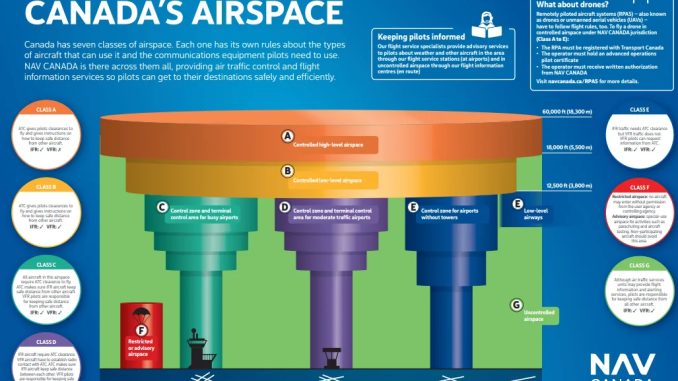
ADS-B OUT, an automatic radio technology that allows superior tracking of aircraft by air traffic control, has been mandatory in aircraft operating in Canada’s Class A (from 18,000 feet to 60,000 feet ASL) and Class B airspace (from 12,500 feet to 17,999 feet ASL) for a few years now. Pending has been a mandate for lower-level airspace, where most smaller, General Aviation (GA), including recreational aircraft, fly.
Nav Canada has now revealed its proposed mandate. There are several aspects that have not been expected by the General Aviation (GA) community. Following are highlights of the proposal, which was issued on November 10:
- Proceed with the previously approved ADS-B requirement for Class E airspace above FL600 as a separate activity.
- Designate Class C airspace and Class D/E transponder airspace as ADS-B airspace.
- Support ADS-B airspace at or below 12,500 feet ASL with surveillance capability that accommodates certified ADS-B Out installations without antenna diversity (emphasis mine).
- Consider ADS-B designation of additional Class D and Class E airspace only where operationally justified.
- Maintain access options for aircraft that are not equipped with ADS-B. Access to ADS-B airspace should be maintained for aircraft operating under applicable exemptions, while requests from aircraft that cannot reasonably or practically be equipped with ADS-B should continue to be considered.
Although all the above proposals count only ADS-B OUT using 1090ES equipage, a more costly choice, there is mention of the more economical 978UAT technology, which is an option in the U.S. but not in Canada.
“NAV CANADA should support FIS-B [live weather] and TIS-B [real-time traffic] functionality as separate capabilities from ADS-B surveillance. FIS-B and TIS-B provide pilot-facing information capabilities that are distinct from the ADS-B Out requirements for ATS surveillance and are not prerequisites for ADS-B airspace. NAV CANADA should support opportunities for third-party development of these capabilities on 978 MHz, without committing to provide, operate, or assume responsibility for the resulting services.”
Nav Canada invites stakeholder input January 19, 2027. Submissions can be made in writing or by email to studies.etudes (at) navcanada.ca.
The complete Notice of Proposal is appended below.
Be the first to comment