

The Transportation Safety Board (TSB) released its investigation report on October 21 into the mid-air collision between two training aircraft at the Steinbach airport (CKK7) in Manitoba. The July 8, 2025, accident claimed the lives of two soloing students, one training towards a commercial licence and the other towards a private licence.
The aircraft involved were a Cessna 172R (C-GZKA) and a Cessna 152 (C-GGPE) and both were in the circuit performing touch and go exercises after taking off from CKK7. Two other aircraft had also taken off from CKK7 while GZKA and GGPE were in the circuit, both subsequently joining the circuit. Although all four aircraft in the circuit were making radio calls, none included distance from the runway threshold while on the final leg.
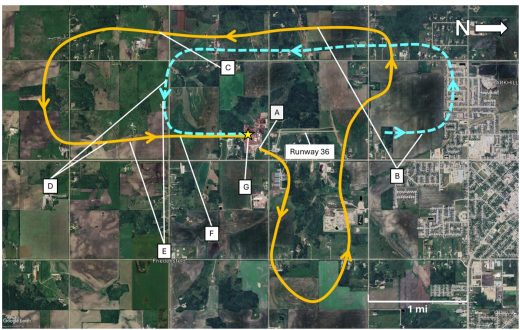
Google Earth with TSB annotations. Legend available on TSB website (see link below).
When both occurrence aircraft were 1 statute mile from the runway, radar records showed GZKA to be about 100 feet directly above GGPE at 08:41:58 local time. At 08:42, the two aircraft briefly made initial contact. GGPE’s pilot applied full power, causing the aircraft to pitch up. Since GGPE was under GZKA, this led to the two aircraft making contact again, subsequently becoming entangled and crashing to the ground about a ¼ mile short of the runway.
The airport is operated by flight school Harv’s Air, to whom two of the four aircraft in the circuit belonged. Safety measures introduced by Harv’s Air since the accident include limiting the circuit to three aircraft at one time, requiring that radio calls announcing final include distance from the runway, all aircraft lights to be continuously on during flight, and mandatory briefings on the importance of see-and-avoid techniques. Harv’s Air has also embarked on equipping more of its aircraft with ADS-B OUT and IN technology.
At the end of the accident report, the TSB discusses ADS-B and its merits:
“NAV CANADA currently requires all aircraft flying into Class A and B airspace to be equipped with a transponder with ADS-B OUT. This mandate will be expanded to Class C, D, and E airspace no sooner than 2028. At the time of report writing, there is no requirement for aircraft to be equipped with a system with ADS-B IN.”
This mandate is designed for Nav Canada-controlled airspace. The ADS-B OUT signal received by ATC will allow ATC to provide traffic separation, principally to IFR traffic and to VFR-to-VFR traffic on a workload-permitting basis. Outside of controlled airspace, ADS-B OUT signals are meaningless to other aircraft unless that aircraft has ADS-B IN equipage.
Regardless, given that this accident occurred in Class G airspace, the pending Nav Canada mandate is irrelevant. Only mandatory ADS-B IN and OUT equipage in all airspace would have provided the occurrence pilots with better situational awareness.
Click here to read the full TSB report.
The TSB report for the Steinbach South mid-air of July 2025 is very disappointing for its lack of direction and action focus related to “see and avoid” technologies.
A25C0066 Previous TSB investigations on mid-air collisions
“Including this one, the TSB has investigated 13 mid-air collision accidents since 2011.,,,”
Again it points out the “see and avoid” visual principals have failed again. This is a continuous theme in other mid-air accident reports dating back from at least 2006 ( A06O0206) but without any recommendations for NavCan and TC to correct it. In the USA the NTSB basically drove the implementation of the ACAS (TCAS) and ADS-B systems to reduce accidents. This approach has borne fruit and the USA mid-air accident rate is almost half of Canada’s rate, (when adjusted for the number of aircraft). This was pointed out in my SECURITAS submission to the TSB on May 4th , which has been acknowledged, but no other communication on the topic has been received: SILENCE. Since that time there has been the Chilliwack mid-air and NavCan sold its $116M stake in AIREON.
Keep in mind that most mid-air accidents have been in CLASS G airspace, often involving training aircraft. You have to ask if NavCan should even be implementing ADS-B technologies without help and consultation.
This is part of a larger document.
A25C0066 Air traffic awareness systems
“NAV CANADA currently requires all aircraft flying into Class A and B airspace to be equipped with a transponder with ADS-B OUT….”
According to NavCan’s published plan, the ADS-B system is all satellite based. Consequently, the TC requirements for Canadian ADS-B OUT dictates a transponder capable of transmitting to the NavCan (AIREON) satellite, and also to the ground based legacy radars. This is a problem for most GA aircraft, especially those which have installed ADS-B systems to the FAA bottom mount standard. This expansive and complicated requirement has stopped most operators from installing Canadian compliant equipment. A few of us have installed this equipment only to find out that the system does not work reliably in critical areas. This is due to “1090 congestion” because of too much aircraft data. The area designated is very large, from Winnipeg to Halifax and as far north as Sudbury. This is a no go for GA and it is the reason that the MANDATE has been delayed so many times!!!
Here is what NavCan has published in December of 2023 in the Public ADS-B Performance Report (PAPR) User Guide. (Not in the original version):
“Due to the congestion on 1090 MHz and the large coverage area of the Aireon satellites’ receivers, aircraft that fly in congested areas are likely to experience variations in PAPR report parameters. Congestion on 1090 MHz cannot be fully mitigated, therefore to receive consistent PAPR reports, aircraft would need to fly outside 1090 MHz congested areas, or alternatively flying at off-peak hours in the normally congested areas can also help to minimize impact on PAPR reports.”
This is a fundamental problem that will probably never be solved with the current satellite constellation and design. NavCan have recommended the use of ground based systems in their report.
A25C0066 Safety Message
“Aircraft owners and pilots are encouraged to install systems that provide air traffic information to enhance pilots’ situational awareness.”
The message here is that, as aircraft owners and operators, we are to solve the basic problem. This is a difficult and expensive problem to solve if you use a NavCan ADS-B solution, especially for a training fleet of aircraft. I see the industry trend is to ignore the TC directive and install FAA compliant ADS-B OUT transponders, either 1090 or UAT transceiver systems, for the best price and functionality. ADS-B IN systems should receive both UAT and 1090 and the antenna should be located on the fuselage for best line of sight performance for traffic and for FIS-B weather. (The CIFIB has attempted to fill this serious FIS-B gap.)
If you install ADS-B IN for training aircraft then particular must be taken when to use the technology. We must remember that ADS-B is not a collision avoidance system. It is an aid to direct our visual scan. Since most airport accidents happen on final, maybe as you turn base, include the ADS-B traffic in that view. Students need to keep their visual scan up and around. Targets would be best displayed on the aircraft GPS screen and audio traffic warnings to the pilot’s headset. Some work is required here for a standard.
The view at our pilot’s forum today was that aircraft should be announcing, not their distance from the runway threshold, but what position they THINK they are in the landing sequence.
“Who’s number TWO?” “Who’s going to be the next ONE?”
We cannot delay any further! We need ADS-B and we need it now, directed for air safety, not NavCan convenience. The TSB needs to step up for safety’s sake.